
Studying Business with Kingdom Purpose
February 20, 2026 2026-02-24 20:58Studying Business with Kingdom Purpose
Summary
Sattler College’s Business Degree program prepares students to approach business as an act of faithful stewardship rather than merely a pursuit of profit. Through rigorous training in finance, management, and strategy, combined with theological reflection and ethical discussion, students learn to think holistically about how businesses function and how decisions affect people and communities. Small class sizes, close mentorship, and the dynamic setting of Boston further shape students into leaders who seek to practice business with integrity, wisdom, and a Christ-centered purpose.
A well-known quote, often attributed to Peter Drucker, states that “The best way to predict the future is to create it.” This highlights the lasting impact of human decision-making made, which is especially observed through the scope of business. Choices about resources, people, and priorities shape not only economic outcomes, but also institutions and communities.
At Sattler College, the study of business invites students to engage with economic systems thoughtfully and responsibly. Rather than focusing on only technical proficiency, students are encouraged to examine how business should be practiced through the lens of biblical teachings on stewardship, justice, and love of neighbor.
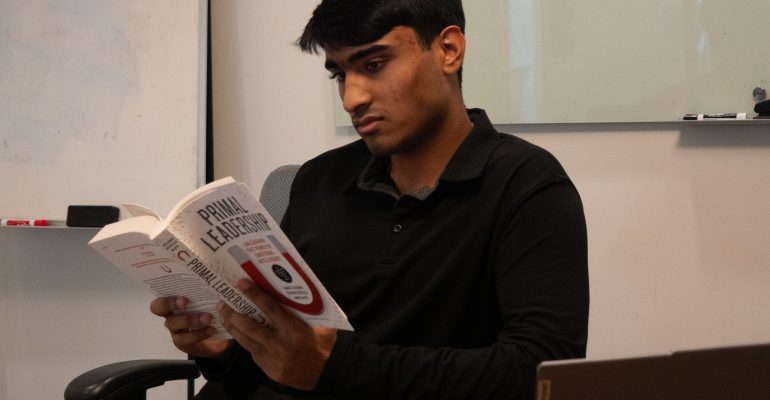
The Business Degree program integrates rigorous academic training with theological reflection. At Sattler students develop practical skills in finance, data analysis, management, and strategy while learning how different components of business work together. Junior business student Nevan Miller described the business program saying:
“It’s made business more accessible. It added a nuance on how the different components of business function… how they act as individual parts of a machine.”
Sophomore Angelyn Kornelsen emphasized the program’s holistic approach, noting that Sattler helped her understand “how the different parts of business work together” and equipped her “to think about business in a way that is actually helpful and realistic.”
While technical skills are important, faith and purpose are central to the business program here at Sattler. Nevan reflected that his faith has made his studies “very meaningful… not something that just sits on my mind but touches me at a soul level,” expanding how he dreams about his future in business through a faith based approach.
Ethical reflection is also embedded throughout the curriculum. Nevan highlighted the idea of sacrificial business, describing it as “taking hits for the business either for the sake of helping out customers or for the sake of employees,” and defined stewardship as “being willing to carry the burden, especially if you have the means to do so.” Angelyn added that discussing ethical challenges in class helps her see business decisions more clearly: classmates’ questions and perspectives “ensure that we are getting a holistic view of the issue.”
Small class sizes further distinguish the Sattler business program. Angelyn explained that small classes increase both access and quality: “The smallest class I’ve been in had eight students… the personalized learning environment actually increases the quality of education.” Nevan added that small classes allow for “unhindered access to professors” and more conversational lectures, fostering deeper engagement and learning.
Located in the heart of Boston, Sattler provides students with a dynamic real-world environment. Nevan described Boston as fostering “a sense of urgency—helpful for dreaming big and taking decisive actions.” In a city full of innovation and growth, students here at Sattler are encouraged to develop an enthusiasm for stewardship and a kingdom business mindset that impacts the world around them through innovation.
At its core, Sattler College’s Business Degree program is designed to form leaders who understand business as a means of faithful stewardship. Through rigorous study, ethical reflection, close mentorship, and a Christ-centered vision, students are equipped to pursue impact beyond profit—building organizations and communities marked by wisdom, integrity, and care for others.




Comment (1)
George Chavanikamannil
Great reflection, Paul. Congratulations!