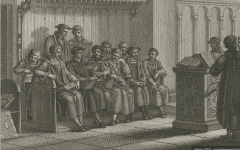
Hubmaier Retracts His Recantation in the Pulpit
January 30, 2026 2026-01-30 22:53Hubmaier Retracts His Recantation in the Pulpit

December 29, 1525
Zwingli and the Zurich Town Council believed they had garnered Balthasar Hubmaier’s cooperation with their reform program when he agreed to recant his position on believers’ baptism. But when he rose to the pulpit of the Fraumünster, the second most important church in Zurich, to read his recantation publicly at a Friday service, he surprised the audience with a speech that defended Anabaptism instead. “Oh how I have had great conflict and tribulation last night over what I had permitted myself to say,” the chronicler Johannes Kessler reported him to say. “Now I must say that I am unable to recant.”1
Hubmaier went on to defend his former doctrine on baptism until Zwingli, who was present at the service, eventually rose and interrupted him. Instead of going free after the church service, as planned, Hubmaier was led off to prison once again. And now the authorities operated on the belief that Hubmaier might have come to Zurich as a plotter of regime change.2 He was promptly placed on the torture rack while interrogators sought to extract information from him about his contacts with revolutionaries of the Peasants’ War and fellow spokesmen of Anabaptism. He was then placed in the Wellenberg in the middle of the Limmat River, where Margaret Hottinger languished, while the Zurich government deliberated what to do with him.3
What would prompt Hubmaier to so dramatically change course, choosing to face the possibility of the physical harms that he dreaded so much before? It appears that knowledge of congregational support from former residents of Waldshut played an important role in his thinking. When he arrived in Zurich and wrote out his recantation, he was a man who felt he was in exile alone, a pastor who had lost his congregation. But during the interrogation that he faced after retracting his recantation, Hubmaier mentioned that he received a letter from a councilman from Constance six or seven days before he was supposed to “perform the recantation.” This councilman, evidently in sympathy with Hubmaier, wrote to say that “the faithful Christians of Waldshut had come to Constance and were very worried about him, and that he should be patient and confident that God would help him in his time.”4 These faithful Christians were likely Waldshut residents who fled when Hubmaier and the city’s councilors warned them they should leave home if they could not in good conscience return to the Catholic worship that the imperial army would impose after the city’s surrender. Constance was a sensible place for such residents to flee, since it was a nearby “free imperial city,” outside the Habsburgs’ control, that had adopted evangelical reforms. Word of these supporters’ prayers for his fortitude and faithfulness likely gave Hubmaier a sense of remorse over “permitting” himself to recant and caused him to contemplate standing up for their Anabaptist reforms when he faced a public audience.
From Zwingli’s perspective, however, Hubmaier had simply proven himself duplicitous. Several months after the event, Zwingli repeated the “speculation” among some in Zurich that Hubmaier had planned all along to feign his readiness to recant to the town council so that he would win a moment in a Zurich pulpit; once there, they suspected, he hoped to stir up a sudden “commotion” that would challenge the Reformed government by rallying public support for Anabaptist reform.5
The rest of Hubmaier’s interrogation record concerning his retracted recantation reads like the utterances of a man whose mind was whirling from illness. They are likely the ill-born fruits of torture, which does not have a strong track record of eliciting truth. Here Hubmaier confesses that his statements in the pulpit were unintended; that he had “fantasized” that imperial authorities were “going to seize him and lead him away”; that in the stress of the moment this apprehension caused him to revert to a defense of his writings that he had prepared for Archduke Ferdinand’s legates who had arrived in the city, “clumsily” reciting the points of that defense, meant for unmerciful officials, before the gracious Zurich councilors instead. He begged “Milords” for renewed grace and mercy.6 Though the records directly from Hubmaier’s interrogations do not verify it, Zwingli told a friendly reformer in Augsburg that Hubmaier went so far as to declare that he was “entirely ignorant of saying anything to vitiate his recantation, and if he said anything else than what he had promised he must have been possessed by a demon.”7
However, there might have been some calculated sense in Hubmaier’s decision to disavow his recantation: if he believed that the Zurich Council was planning to hand him over to Habsburg legates after his recantation, rather than allow him to stay, he might have figured that recanting Anabaptism in favor of Zwinglian theology would be of no benefit; if he was headed for death in the Habsburgs’ custody, he might have decided he would rather be known for staying true to his Anabaptist writings.8 This theory is rational. But it would not explain why Hubmaier, without any better information about the Zurich council’s response to the Archduke’s legates, quickly returned to his willingness to comply with Zurich’s official position on baptism: “He holds infant baptism to be godly, right and good,” the clerk at the interrogation recorded. “He said this and confesses this with heart and mouth.”9 The fear of further torture in Zurich’s own prisons likely played the most prominent role in his decision, overcoming even the courage he drew from his colleagues’ encouragement in Constance.
Despite declaring his renewed desire to conform to Zwinglian views of baptism, Hubmaier did not win release. He remained in prison for close to four months while Zwingli and the town councilors looked for a good moment to move him out of the canton without Anabaptist allies or imperial forces noticing. Zwingli portrayed his efforts during this period of imprisonment as a gracious gesture for a man he now scorned. Instead of simply handing Hubmaier over to the Habsburgs’ legates, Zwingli wrote, the Zurich government “defended him from the demand of Caesar just as though he were a citizen!” And when some councilors planned for Hubmaier to write out his second recantation and then leave the canton immediately, Zwingli apprehended that Hubmaier would then fall in “grave peril” of being captured by “Caesar” or even by Catholic Swiss who anticipated they could win a reward for handing the wanted theologian over to the Habsburgs. Zwingli spearheaded an effort for the Council to release Hubmaier secretly so that he would be in another territory before anyone else knew he was out of prison.10 That opportune moment did not come until April.
About This Series
This post is part of a series entitled “The Reformation at 500: Timeline of the Free-Church Movement.” Click here for more information on this series.
Featured image courtesy of the Wick’sche Sammlung, ca. 1575, Zentralbibliothek Zurich, Ms. F 23, fol. 294.
- H. Wayne Pipkin & John H. Yoder, eds., Balthasar Hubmaier: Theologian of Anabaptism (Scottdale, PA: Herald Press, 1989), 151, 234; Torsten Bergsten. Balthasar Hubmaier, Anabaptist Theologian and Martyr, ed. W. R. Estep Jr. (Valley Forge: Judson Press, 1978), 304. ↩︎
- In a letter to Wolfgang Capito, evangelical reformer of Strasbourg, Zwingli wrote that the Council’s purpose in arresting Hubmaier in December, when his presence in Zurich became known, was not to debate his position on baptism, but to make sure that he could not secretly plot any upraising among Zurich residents who were discontent with the city’s reforms. This letter indicates the level of Zurich councilors’ fear that Hubmaier was skilled in spurring political change, not just religious change, with his preaching and was therefore a threat to their positions in power. Zwingli to Capito (Zurich, Jan. 1, 1526), in Pipkin & Yoder, Hubmaier, 155; Bergsten, Hubmaier, 300. ↩︎
- Pipkin & Yoder, Hubmaier, 151; Bergsten, Hubmaier, 304. ↩︎
- Fragments of an Interrogation, in Pipkin & Yoder, Hubmaier, 154. ↩︎
- Zwingli to Peter Gynoräus (Zurich, Aug. 31, 1526), in ibid., 158. ↩︎
- Fragments of an Interrogation, in ibid., 154. ↩︎
- Zwingli to Peter Gynoräus, in ibid., 158. ↩︎
- Bergsten gives this explanation at Hubmaier, 305. ↩︎
- Fragments of an Interrogation, in Pipkin & Yoder, Hubmaier, 153-54. ↩︎
- Zwingli to Peter Gynoräus, in ibid., 159. ↩︎