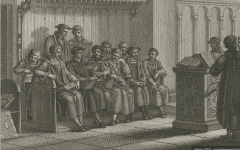
Hubmaier is Arrested and Signs Recantation in Zurich
December 12, 2025 2025-12-12 21:27Hubmaier is Arrested and Signs Recantation in Zurich

December 19,1525
After fleeing Waldshut, Balthasar Hubmaier made it to the Swiss Confederacy without being detected by the imperial soldiers who were looking for him. But his arrival in the canton of Zurich did not go unnoticed, and within two weeks of his flight, he found himself under arrest by the Reformed government there.
Hubmaier recalled his flight a few months later during an interrogation run by the Zurich authorities. As the clerk at the interrogation recorded, Hubmaier at first “didn’t know where he should go” once he escaped Waldshut and found a boatman who spirited him across the Rhine River to the Swiss side. “He had in mind to go toward Basel and Strasbourg but Habsburg troops were encamped there, so that he could not dare to go that way.” So he came into Zurich’s territory, apparently learning of an Anabaptist, Heinrich Aberlin, who was willing to take him in. He “thought that he would rest a day or two, because his feet were greatly swollen, and would get other clothing, because in his old clothing he was too recognizable and easily betrayed.” Hubmaier said that he had already felt “deathly sick” in the days before he fled Waldshut, so his physical ailments were compounded after his sudden trek in the winter with insufficiently warm clothes.1 As he wrote in his statement to the Zurich Council after his arrest: “I have no coat of my own to wear. I escaped only with the shirt on my back.”2 He soon moved on to the home of a widow, Anna Widerker, hoping that with a bit more rest he would be able to travel onward.3
But by December 19, the Zurich Council knew of his whereabouts and ordered that Hubmaier be taken into custody. Worried that Hubmaier’s presence in the prison would influence other prisoners with interest in Anabaptism, the Council had him held in the city hall instead. Soon, Hubmaier’s desire to dialogue with Zwingli and the city’s other reforming theologians was granted; Zwingli was prepared to meet the new prisoner, accompanied by several other Swiss Reformed leaders: Leo Jud, Oswald Myconius, Sebastian Hofmeister, Kaspar Megander, and Heinrich Engelhard.4
Hubmaier and Zwingli now had opportunity to debate in person the points of scriptural interpretation that they had covered in their tracts over the prior few months. Zwingli recounted the conversation with his new theological adversary several months later in a letter to an ally, recalling that they covered Acts 2, “from which I proved that the children of Christians were in the beginning reckoned as of the church.” Hubmaier, however, would not agree that they were in the church, holding that belonging to the body of Christ was a matter of faith in Christ. Likewise, when Zwingli turned to Paul’s statement that the Israelite fathers were “all baptized into Moses in the cloud and the sea,”5 Hubmaier was also unwilling to admit that “children were included even though they were not explicitly mentioned.” After this, Zwingli recalled, “I must confess that I went for the man rather vigorously.”6 All political leverage lay in the hands of Zwingli and the Council to bring him into alignment with their model of reform if he wished to enjoy Zurich’s refuge; they found Hubmaier in weak physical condition, they knew he could be a prize to trade with the Habsburgs to bolster Zurich’s diplomatic interests, and they had the threat of the “rack” at their disposal to prod him to reveal more about his involvements in Waldshut.7 It is unknown whether Zwingli made that reality explicit to Hubmaier at this meeting, but Zwingli boasted a few weeks later that he had “rendered him mute as a fish.”8 Hubmaier agreed to recant his teaching on baptism. He prepared a written recantation to be given to the Zurich Council, which scheduled him to read it publicly from the pulpit of Zurich’s second largest church on an upcoming Sunday.9
In the recantation, Hubmaier encapsulated his theology of baptism briefly as an individual’s response to the faith that he or she felt growing after encountering the Word of God: “I, Baldasar Huebmor from Fridberg, confess publicly and in my own hand that [in the past] I could only understand all the Scriptures which deal with water baptism as saying that first one should preach, then one believes, and then one is baptized.” Now, however, Hubmaier conceded that Zwingli had shown him that “baptism takes the place of circumcision” as a “covenant sign” for the “covenant of God, made with Abraham and his seed.” Moreover, Hubmaier wrote he had been shown “how love is to be judge and referee in all Scriptures. This went to my heart. So I have meditated much about love, and have at last been moved to abandon my conviction that one should not baptize children.”10 These lines satisfied Zwingli that the people would hear endorsement of the themes he had been developing in his writings in response to the growth of Anabaptism: whereas Anabaptist sectarians were celebrating the intimacy of their congregational fellowship and the sense of brotherly love that arose when believers felt they were gathered together with a common commitment to follow the model of Christ, Zwingli wished to portray their mindset as lacking in love. He thought their insistence that baptism and membership in the church were for active disciples only made them unwilling to forbear the shortcomings of neighbors who needed to be continuously welcomed into the church to hear its words of grace. And he presented their withholding of baptism from children as distancing them from the assurance that God’s covenant included them. If Hubmaier had come around to accepting this position, it would serve Zwingli’s reformation aims very well.
Hubmaier, however, wrestled further in his conscience as he awaited the day of his public recantation. When the day arrived, he would have a surprise in store for Zwingli.
About This Series
This post is part of a series entitled “The Reformation at 500: Timeline of the Free-Church Movement.” Click here for more information on this series.
Featured image courtesy of the Wick’sche Sammlung, ca. 1575, Zentralbibliothek Zurich, Ms. F 23, fol. 294.
- Interrogation of Balthasar Hubmaier (Zurich, March 1526), in H. Wayne Pipkin & John H. Yoder, eds., Balthasar Hubmaier: Theologian of Anabaptism (Scottdale, PA: Herald Press, 1989), 161. See also Torsten Bergsten. Balthasar Hubmaier, Anabaptist Theologian and Martyr, ed. W. R. Estep Jr. (Valley Forge: Judson Press, 1978), 266. ↩︎
- Recantation (Zurich, Dec. 19, 1525), in Pipkin & Yoder, Hubmaier, 152-53. ↩︎
- Interrogation (Zurich, March 1526), in Pipkin & Yoder, Hubmaier, 161. ↩︎
- Zwingli to Peter Gynoräus (Zurich, Aug. 31, 1526), in Pipkin & Yoder, Hubmaier, 156. ↩︎
- 1 Corinthians 10:2. ↩︎
- Zwingli to Peter Gynoräus (Zurich, Aug. 31, 1526), in Pipkin & Yoder, Hubmaier, 157.
↩︎ - Zwingli alluded to these options in his letter to Gynoräus, ibid., 158, and a letter to Strasbourg reformer Wolfgang Capito, who wrote him in December out of concern that Hubmaier’s might be treated too harshly in Zurich’s hands. See Zwingli to Capito (Zurich, Jan. 1, 1526), in Pipkin & Yoder, Hubmaier, 156. ↩︎
- Ibid., 155. ↩︎
- Pipkin & Yoder, Hubmaier, 151. ↩︎
- Recantation (Zurich, Dec. 19, 1525), in Pipkin & Yoder, Hubmaier, 152-53. ↩︎