Evangelical Preachers Arrive in the Tyrol, Where Anabaptism Rapidly Spreads
February 13, 2026 2026-02-13 21:26Evangelical Preachers Arrive in the Tyrol, Where Anabaptism Rapidly Spreads

January – February 1526
In the fall of 1525 and winter of 1526, agitation for church and political reform arrived in the Tyrol, the high Alpine region under Austrian Habsburg control. Several individuals who would later become preachers of Anabaptist concepts of the sacraments and advocates of free-church ecclesiology began itinerant preaching in the mountain villages of the region at this time. Their preaching laid the groundwork for an especially strong interest in Anabaptism over the next few years.
Two itinerant preachers who surface in records multiple times were Mathias Messerschmied and a goatherd named Wolfgang or “Wölfl.” Messerschmied had been a canon of a church in the Puster Valley before he was imprisoned for heretical beliefs in 1524 and then headed to Augsburg. Returning to the Tyrol, he distributed literature that he brought from Augsburg critiquing the church’s presentation of the sacraments. Now married, he and his wife hosted meetings where they would read these pamphlets and the Scriptures aloud, since many in the region had not yet learned to read. Wöfl was one of those agrarians who would typically rely on others reading aloud to learn the Scriptures, but he traveled to the city of Innsbruck in 1525-26 and learned how to read from a schoolmaster. Returning to the Puster Valley, he joined the Messerschmieds’ meetings and began preaching. A year later, when he was arrested, he testified that he believed the Mass had become a form of idolatry, and the priests treated it like “a piece of merchandise which the merchant locks up so that he may make some money of it.” These sentiments were likely part of his preaching from early 1526 onward, as they resonate with Messerschmied’s emphases, as well. When Lent 1526 began, Messerschmied and Wöfl were part of a group who gained notoriety in the area for flouting the church’s traditions by intentionally eating sausages—much like Christoph Froschauer and Zwingli’s associates had done in Zurich during Lent 1522.1 In both cases, the act appeared to be intended to assert freedom from priestly traditions and to draw a contrast to the more basic practices of worship found in the New Testament.
Others who were pressing for church and political reform in the Tyrolean Alps displayed agreement with Zurich’s style of reformation. For instance, a former Dominican monk from Ulm named Hans Vischer also came to authorities’ attention in the Lenten season of 1526. Speaking in taverns and shops, he reportedly taught that there was “nothing to mass,” indicating a Zwinglian view that the Lord’s Supper should be treated simply as a memorial of Christ’s sacrifice. He complained that the nobles led men into unjust and unnecessary wars and suggested that the people would be better off managing the land without them.2 And most notably, there was Michael Gaismair, who rose to leadership of a band of peasants who had already taken up arms against the lords of the Tyrol in August of 1525. The rebellion failed, and Gaismair was taken to the court city of Innsbruck under arrest. But in October 1525, he managed to break out of the jail where he had been held and fled to the Swiss cantons of Graubünden and Zurich. The cantonal governments gave him refuge, viewing him as a useful ally to them if he were to weaken the Habsburgs’ oversight of the territories to their east. It also appeared to Zwingli and his associates that Gaismair could become a comrade of theirs on religious grounds. With the freedom and support Zurich officials gave him—at the same time that Hubmaier sat in prison—Gaismair used his refuge to recruit more volunteers to stage another rebellion against the Catholic overlords in the Tyrol. To assist in that endeavor, Gaismair wrote up a proposal for a “Territorial Constitution” (Landesordnung) for Tyrol, which he and his army members pledged to implement if they were to gain power. In February or March, Gaismair published it as a flyer that could be easily distributed. Zwingli likely advised him on the text, which sets out a vision of republican governance much like Zurich’s. Before going into details about the operation of courts and the management of farmlands and mines, the signatories swore to establish “laws which are wholly Christian” and “expel all godless people, who persecute the eternal word of God, burden the poor commoner, and impede the common good.” Monastic cloisters would be turned into public hospitals and all “chalices and jewelry should be taken from all churches and ecclesiastical building, melted down, and used for the common needs of the territory.”3 The pitch would be effective enough to rally a group of miners and farmers intent on overthrowing the prince-archbishopric of Salzburg later in the spring.4
Messerschmied, Wölfl, and Vischer all seem to have envisioned their desired church reforms being advanced by political and military means, like Gaismair’s peasant rebellions. When Wölfl was challenged by a conservative priest, Messerschmied and his Bible study associates even joined with a group of miners pledging to “protect and defend” him, by implication with arms, and they likely nailed a threatening letter against the priest to his church door.5 But after Gaismair’s Salzburg rebellion failed, people who had come under their influence would be open to envisioning a different approach to church reform—one that they would encounter when George Blaurock came to their region a year later, emphasizing personal moral commitments rather than top-down civic imposition of “godly law.” Messerschmied himself would become an Anabaptist, and one of the men who heard Wölfl teach in 1526 would, after a few years of spiritual struggles, eventually emerge as the most consequential evangelist for Anabaptism in the region: Jakob Hutter.6
About This Series
This post is part of a series entitled “The Reformation at 500: Timeline of the Free-Church Movement.” Click here for more information on this series.
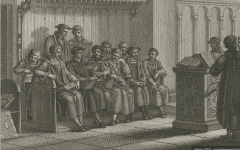
Featured image courtesy of the Wick’sche Sammlung, ca. 1575, Zentralbibliothek Zurich, Ms. F 23, fol. 294.
- Werner O. Packull, Hutterite Beginnings: Communitarian Experiments during the Reformation (Baltimore: Johns Hopkins University Press, 1995), 176-77, 179-80. ↩︎
- Ibid., 176-77. ↩︎
- Michael Gaismair, Territorial Constitution for Tyrol (1526), in Michael G. Baylor, ed. and trans., The Radical Reformation (Cambridge: Cambridge University Press, 1991), 254-60. ↩︎
- Baylor, 262. For more on Gaismair, see Walter Klaassen, Michael Gaismair: Revolutionary and Reformer (Leiden: Bill, 1978). ↩︎
- Packull, Hutterite Beginnings, 177. ↩︎
- Ibid., 178, 183. ↩︎