Anabaptist Leaders Escape from their Zurich Prison
March 21, 2026 2026-03-21 1:52Anabaptist Leaders Escape from their Zurich Prison

March 21, 1526
Just two weeks after their sentence to prison on bread and water alone, the convicted Anabaptist men made a surprising escape from the Zurich prison where they had been held. They had all been held together in the same cell in the “New Tower,” which allowed them to escape as a group. Most of the group fled the city immediately, going in different directions, in pairs or trios.
Two members of the group, however, were already so weak from their diet of bread and water that they could not manage to flee the city. As soon as prison guards realized the escape, they sent out search parties and discovered the two that same night. These men—Wilhelm Exell and Fridli Ab-Iberg, who had baptized him shortly before their arrest1—were placed back in prison and put on trial two weeks later. Their testimony at the trial allows the daring escape to be reconstructed.
Exell told the Council at his trial that Karl Brennwald—who had just accepted baptism from Anthony Roggenacher in January 1526 and began baptizing others shortly before his arrest2—noticed a window shutter was unlocked. Grebel, Blaurock, Mantz, and Ockenfuss, as well as Exell, initially thought that they should not try to take advantage of the situation, but rather “die in the Tower.”3 But apparently their minds changed when another member of the group broke loose a different shutter and, with it, pried the first shutter open. Using books and blocks of wood that they had with them in the cell, they propped the shutter open wide enough so that several prisoners could fit through the gap and climb up a wall.
From their perch, the first ones up, including Felix Mantz, saw a prison guard close the drawbridge over the prison moat, lock it, and leave the area. Informing the others that there seemed to be a free opportunity to escape, they obtained a rope and a capstan to pull other members of the group up the wall and then lower them down the other side. Although the New Tower was surrounded by a moat, the moat happened to be drained at the time, meaning that as soon as they were down the last wall they could run free.
The group quickly had a discussion about where they would go. Exell recalled that some “joked among themselves and said they would go to the red Indians across the sea.” Joking aside, this is an interesting piece of evidence about their consciousness of the people in the New World and the tantalizing possibilities that the faraway lands posed for those who felt they could no longer fit into their own society in Europe.4
Although some of the individuals who escaped that night never appear in records again, there is no evidence that any made it to sea. For Exell and Ab-Iberg, their freedom was especially short-lived. Ab-Iberg was so ill by the night of the escape that he lost consciousness once he made it down the last wall with the rope. Realizing his weakness, he knew he could not flee far into the woods like the others. Fortified by a bit of food and drink that Hans Ockenfuss gave him, he went into town and was seized there. In his testimony to the Council, he explained that he could neither read nor write. But “Grebel, Mantz, and Blaurock had read and strengthened him and the others in the Tower,” giving a small picture of the spiritual life that the men carried on during their two weeks in the prison together. Through their reading, Ab-Iberg said, “he had believed in the Scripture.”5 That the Zurich government permitted them to have books with them in their prison cell is also an indication of its commitment to foster the study of the Word among the common people. Unfortunately, the Zurich authorities likely rued this decision when learning that the Anabaptist men ultimately found the books useful in an unexpected way to make their escape.
The Town Council decided not to recommit Exell and Ab-Iberg—both from Catholic cantons to the south of Zurich—to the Tower. Instead, it expelled them from the territory of Zurich with the warning that “if they come in again they shall that very hour be drown without mercy.”6 Despite the stern language of these warnings, this punishment was another example of the Zurich government tempering its attempt to stop the spread of Anabaptism among its citizens with a measure of mercy; at this point, councilors kept holding out hope that the Anabaptist fervor might subside before they felt the need to resort to the spectacle of executions.
About This Series
This post is part of a series entitled “The Reformation at 500: Timeline of the Free-Church Movement.” Click here for more information on this series.
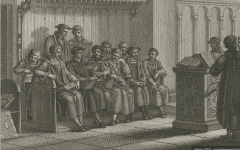
Featured image courtesy of the Wick’sche Sammlung, ca. 1575, Zentralbibliothek Zurich, Ms. F 23, fol. 294.
- Leland Harder, ed., The Sources of Swiss Anabaptism: The Grebel Letters and Related Documents (Scottdale, PA: Herald Press, 1985), 746 f. 1. ↩︎
- In February, Brennwald baptized Ernst von Glätz from Silesia, who was now among the prisoners in the New Tower along with him and Roggenacher.. Ibid., 445, 531. ↩︎
- Investigation in the Escape and Sentence, April 4, 1526, in Ibid.,, 450. ↩︎
- Ibid., 450-51. ↩︎
- Ibid., 452. ↩︎
- Sentence, April 4, 1526, ibid., 452. ↩︎