Concerning Scholars and Those Who Burn Them: A Study of the Early Anabaptists’ Rejection of Higher Education
March 21, 2026 2026-03-21 2:59Concerning Scholars and Those Who Burn Them: A Study of the Early Anabaptists’ Rejection of Higher Education
Concerning Scholars and Those Who Burn Them: A Study of the Early Anabaptists’ Rejection of Higher Education
Summary
This essay explores why many early Anabaptists became suspicious of higher education despite having highly educated founding leaders. Drawing on Anabaptist writings and historical context, it argues that concerns about wealth, status, theological complexity, and clerical corruption contributed to a movement that increasingly valued simplicity of faith over scholarly training.
A Movement Born from Scholars
When one surveys the early Anabaptists, it is almost shocking how many early leaders were educated and knew a multitude of languages. Among them are well-known names – Felix Mantz, Conrad Grebel, Balthasar Hubmaier, and Michael Sattler – all of whom are recorded as being knowledgeable of at least Greek, Hebrew, and Latin, showcasing that they had spent quite a few years in study. However, this educated start did not last, and instead, many of the later Anabaptists would have only a lower-level education, only able to read and write (in their native tongue) sufficiently to study Scripture, but not much else (despite exceptionally strong Bible memorization, as exemplified in their testimonies).
This vast disconnect should cause us to ask: What happened? Why did these initially highly educated leaders not encourage education among those they brought to believe as they did? What thought process caused these humanistically trained leaders to form a group that would popularize the saying, “Die Gelehrter, die Verkehrter”1 and hang onto it even to the present day?2
An analysis of several Anabaptist and Protestant documents shows that there were three primary theoretical motivations for their avoidance of higher education, all of which dealt with then-current problems among the scholarly class. Firstly, they saw scholarship and hierarchical clergy as a scheme seeking money, fame, and titles, which they considered unbiblical. Secondly, and relatedly, they equated being well educated with being rich and thus considered that the more educated one was, the harder it would be to enter the kingdom of heaven. Finally, they saw scholars as deviating from a treasured simplicity of faith, causing corruption and alienating the lay people. These three factors, when combined with practical concerns such as persecution and the need to provide for their families despite oppression, are the primary reasons that Anabaptists, by and large, did not attempt to keep their leaders and themselves highly educated.
It would not be fair to continue without mentioning that while these decriers of higher education painted with a broad brush, they did mention that it was good to be educated enough to read and write.3 In addition, some who were well educated were innocent of the abuses and attacks and were carefully excluded from the anti-education rhetoric. Pious leaders such as Paul, Luke, Michael Sattler, Felix Mantz, and Conrad Grebel, who happened to be well educated, were not the target of these sayings and opinions, but unfortunately, they were the exception rather than the rule.
Why Early Anabaptists Distrusted the Learned
The quest for fame, riches, and titles is nothing new to scholarship, and Anabaptists identified this trend quite well. In a document by Menno Simons titled “Foundations,” he addresses his learned companions as follows: “And I turn to you, O learned ones, you who think that you have the keys of heaven and are the eyes and light of the people. … I see plainly that both you and those you teach run confidently into the eternal destruction of your poor souls.”4 His critique of them was essentially that as “learned ones,” they thought that they were secure from error, and since Menno believed them in error, he pointed out that this was a false view. While he doesn’t directly accuse them of seeking fame here, he argues against a common understanding amongst them that being learned would allow the clergy to be the “eyes and light of the people.” Since Anabaptists considered many clergy to be in error, it could easily make for some measure of dissatisfaction with scholarship.
A problem more obvious than seeking fame in the Anabaptists’ eyes, however, would be seeking riches,5 in opposition to Matthew 19:24. This subject comes up a few times in a poem written by Valentin Ickelsamer that was likely well circulated among the Anabaptists. For example, it reads, “Who collected the treasures of this world, / with indulgences and Turkish money? / Indeed, none other than the scribes.”6 The practice of indulgences, of course, referred to the oft-decried practice of buying one’s way out of purgatory that caused Martin Luther’s 1518 head-to-head with Cardinal Cajetan, both learned men, which would soon lead to his excommunication. Ickelsamer, then, was feeding off of this widely known problem and pointing out that the clergy were the ones responsible for collecting those indulgences, and since the clergy tended to have the best education, it seemed like an easy tie to make.
Ickelsamer would also point out another problem with higher education specifically – that of seeking titles, (supposedly) in violation of Matthew 23:8. Tying in the earlier theme of fame, he writes,
“likewise be masters of God’s congregation,
thinking they are the only ones that know anything.
Because they have the proper title,
they are called master and doctor,
even though it is written
that all Christians are taught of God.
Among them no one should be called master; Mt 23 (8)”7
It seems clear that Ickelsamer considered the pursuit of titles to be vanity and an attempt for those who had the titles to dictate what was being taught in the church. In opposition to this, reformers like Grebel had early on already refused to use titles when addressing others,8 expecting that since both were brothers, that should be enough to go on for them to correspond as equals – no title(s) should be needed nor sought. Their interpretation of Luther’s doctrine of the priesthood of all believers was at play here, causing the comment that “all Christians are taught of God” – it shouldn’t take a special education to see basic biblical truths, as some clergy seem to have been claiming.
When Education Became Spiritually Suspicious
Another major reason for the Anabaptists’ aversion to higher education was their equation of being highly educated with being rich, making it hard to enter the kingdom of heaven. Ickelsamer points this out, saying,
“What Christ says of the wealthy
also applies to the learned ones and their ilk,
that they can enter the kingdom of heaven
only with much difficulty and grief. Mk 10 (23–25) …
knowledge without love is vain poison. Mt 22 (14); 1 Cor 1 (26)”9
Likely because of the earlier-mentioned problems with seeking riches among the educated, Ickelsamer connects the two and points out that a critical ingredient, love, is often missing in scholarship, thus making the knowledge poison and malice10 instead of useful for building up. Since there was such corruption among the clergy, especially in financial matters (as exemplified in indulgences), Anabaptists seem to have linked the two groups together to be one and the same – those with riches were the same as the learned ones.
While it may initially be surprising that they linked scholarship with being rich, it is important to consider that the cultural backdrop for them was far different than the one we are in today. Many of the schools at the time were run by monastic orders and often were well funded by the nobles, thus having very low or no tuition costs;11 and tended to set up their scholars for positions of high regard that frequently brought them a lot of money. This stands in contrast to today, where tuition costs are through the roof, and whether one has a degree doesn’t really dictate whether one will be rich. In those days, the teaching (especially among Catholics) would have been largely geared towards bringing people into the priesthood, which (it was expected) would also involve being well funded. In addition, most of the time, these highly educated clergy would also be nobility, meaning they likely had deep pockets to begin with.
An example of these factors is found in Mathias Hovius’ story as retold in A Bishop’s Tale, where the apparent lack of funding for the archbishop position caused it to be rejected by the two top choices for the job – and it took King Philip quite a while to ask Mathias whether he wanted to take over the role due to his lack of noble lineage and/or deep pockets.12 The King didn’t want to have to fund this position, and he seems to have expected that the person to fill the role should either have some other sources of funding or deep pockets themselves.13
The Gospel and the Fear of Complexity
A final accusation that was made from many sides against the well educated is that they deviated from the simplicity of faith – in other words, they were trying to bring in worldly wisdom in violation of 1 Corinthians 2:1–5. This is a refrain repeated a few times in Ickelsamer’s poem, such as when he writes
“[and] the institutes of higher learning, all of whom
have ruined Christendom
with their questions,
arguments, and opinions,
with their inquisitiveness and their worldly wisdom—”14
In another place, he expresses similar sentiments, remarking, “Who was it that desecrated the simplicity of faith, / breaking up your covenant in many a way? / It was the scribes with their tricks and savvy!”15 As we can clearly see, the university’s methods of “questions, arguments, and opinions” were not well received by Ickelsamer and his ilk. He considers them to be tricks that desecrate the simplicity of faith, ruin Christendom, and break the covenants God has set up with us. A more broad accusation could probably not be found – he was making higher education (or at least, the higher education that wasn’t pious) out to be the devil and his works. With an attitude like this, it is not at all surprising that the number of Anabaptists with an undergrad or graduate degree dropped off significantly!
Recovering a Faithful Vision of Learning
Other reformers expressed similar sentiments about the clergy, especially those who followed Aquinas heavily, overcomplicating spiritual matters from both Anabaptist and non-Anabaptist backgrounds. For example, in Grebel’s letter that I mentioned earlier, he laments the fame of the learned men, saying, “We are also similarly in conflict with our learned pastors. Everybody clings to them. They have generated this by preaching a sinful, sweet Christ, and they lack a good analysis.”16 The idea of a sinful, sweet Christ is likely the same thing that Ickelsamer attacks in his poem when he says, “Scripture is nothing but a bag of tricks / with which they perform their monkey games.”17 It also underlies the request by the peasants to have someone who would “preach the gospel to [them] purely and clearly, without any additional human doctrine or commandments.”18 Too much of Aquinas’s scholastic thought in scholarship and a lot of humanistic influence of ad fontes19 caused these writers, and Anabaptists more broadly, to desire that the doctrine they were taught would be in a language common to all and would not be based on a lot of theological wrangling that could hardly be understood unless they too were also highly educated. They saw a disconnect between the simple words of the gospel that, due to the printing press, they were reading and the “sinful sweet” doctrine that they were getting in churches, and they blamed this largely on the education that would allow these men to change their theological position from day to day.20 As a result, they rejected the institutes of higher learning and insisted that all should be able to offer an interpretation of Scripture, readable by all and available for critique by all who cared to do so regardless of the level of education that person possessed.
In conclusion, the anti-scholastic sentiment expressed by many Anabaptist reformers is largely a result of the problems they saw with the highly educated groups of the time. The “learned” clergy’s quest for fame, riches, and titles contradicted what Christ told us to seek, and so they rejected it completely. Similarly, they considered the quest for learning to be so tied to the quest for riches that they tied the two together and generalized that those who were highly educated would have as hard of a problem getting into heaven as rich people would. Finally, they saw a disconnect between the simple truth of the gospel and what they were hearing from their highly educated theological leaders. These rampant abuses, combined with some of the practical problems noted earlier, are what caused the Anabaptists to mostly avoid higher education despite an early educated start. May we avoid being the ones who cause this attitude to live on and instead gently and humbly seek to bring our brothers and sisters to a fuller knowledge of the truth of Christ that does not distinguish based on worldly wisdom.
May we avoid being the ones who cause this attitude to live on and instead gently and humbly seek to bring our brothers and sisters to a fuller knowledge of the truth of Christ that does not distinguish based on worldly wisdom.
- The scholars, the twisted/corrupt. (My translation). ↩︎
- A variant of this saying, “Je Gelehrter, je verkehrter” (The more learned, the more twisted) showed up in a recent conference letter sent to the Schmiedleut group two. Leonard Kleinsasser and Jacob Wipf, “Konferenz Brief,” November 24, 2024. Pg 3. ↩︎
- Valentin Ickelsamer, “Preface 2: ‘The Learned Ones, the Wrongheaded Ones,’” in Jörg Maler’s Kunstbuch: Writings of the Pilgram Marpeck Circle, by Jörg Maler, ed. John D Rempel, trans. Gerhard Reimer, vol. 12 (Walden, NY: Plough Publishing House, 2019), 16–31. Ln 471–475. ↩︎
- Menno Simons, “Foundation, 1539,” in The Complete Writings of Menno Simons, ed. J. C. Wenger (Scottdale, PA: Herald Press, 1956), 207–8. ↩︎
- I later address scholars “being rich,” and distinguish the two because of how they seem to be addressed as two separate issues by Anabaptists. One deals with the state of riches, and one with the attempt to gain riches. ↩︎
- Ickelsamer, “Preface 2: ‘The Learned Ones, the Wrongheaded Ones.’” Ln 203–205. ↩︎
- Ickelsamer. Ln 338–344. ↩︎
- Conrad Grebel, “Letter to Thomas Münster,” in The Radical Reformation, ed. Michael G. Baylor, Cambridge Texts in the History of Political Thought (Cambridge: Cambridge University Press, 1991), 36–48. Pg 36. ↩︎
- Ickelsamer, “Preface 2: ‘The Learned Ones, the Wrongheaded Ones.’” Ln 436–439; 444. ↩︎
- As he says in another spot, “Even if there was something good in it / it does not appear that way / because of all the berating and malice of every kind.” See: Ickelsamer. Ln 233–235. ↩︎
- John Witte, “The Civic Seminary: Sources of Modern Public Education in the Lutheran Reformation of Germany,” Journal of Law and Religion 12, no. 1 (1995): 173–223. Pg 182–183. ↩︎
- Harline Craig and Put Eddy, A Bishop’s Tale: Mathias Hovius Among His Flock in Seventeenth-Century Flanders (New Haven, Conn.: Yale University Press, 2000), http://search.ebscohost.com/login.aspx?direct=true&db=nlebk&AN=187865&site=eds-live&scope=site. Ch 2: The Third Man. ↩︎
- This also demonstrates an exception to the rule: Mathias, despite his education, ends up taking the job regardless of the fact that it had a lack of funds. ↩︎
- Ickelsamer, “Preface 2: ‘The Learned Ones, the Wrongheaded Ones.’” Ln 72–76. ↩︎
- Ickelsamer. Ln 214–216. ↩︎
- Grebel, “Letter to Thomas Münster.” Pg 41. ↩︎
- Ickelsamer, “Preface 2: ‘The Learned Ones, the Wrongheaded Ones.’” Ln 395–396. ↩︎
- Michael G. Baylor, ed., “The Twelve Articles of the Upper Swabian Peasants,” in The Radical Reformation, Cambridge Texts in the History of Political Thought (Cambridge: Cambridge University Press, 1991), 231–38. Pg 233. ↩︎
- Ad fontes generally means “Back to the sources,” and while it can indicate an eagerness to go back to the original languages, I am using it to indicate wanting to go back to just the Bible. ↩︎
- As Ickelsamer put it, “Now it’s a stone, and then it’s bread.” Ickelsamer, “Preface 2: ‘The Learned Ones, the Wrongheaded Ones.’” Ln 394. ↩︎
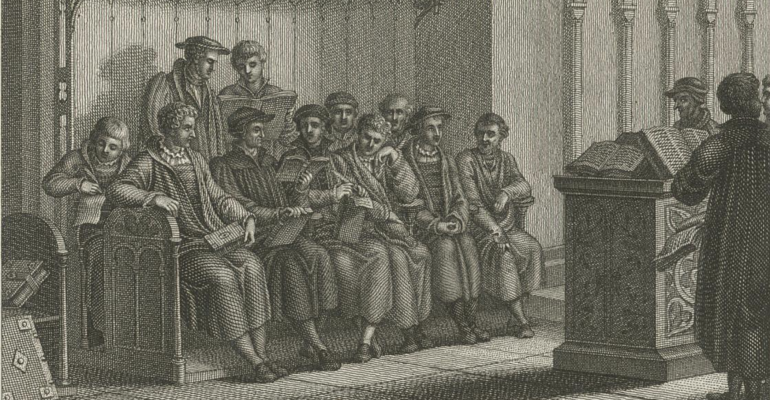
Featured image: Johann Martin Usteri, Bullinger, Jud, Zwingli und Pellikan (etching), Zentralbibliothek Zürich. Public Domain. https://doi.org/10.3931/e-rara-46437.